August 17th, 2016

Sometimes real life is stranger and more interesting that any made-up story. These weird and interesting facts about braces will amuse you … and make you glad you didn’t have to get braces “way back when.”
Mummies with braces: Archaeologists have discovered mummies with crude bands of metal wrapped around their teeth. The metal was wrapped around each individual tooth, and it is believed that ancient dentists used catgut to guide the teeth and close the gaps.
First “official” braces: The first official braces were constructed in 1728 by Pierre Fauchard. They consisted of flat strips of metal. String was used to connect the metal to the teeth.
Early rubber bands: In 1850, Tucker began making rubber bands out of rubber tubing.
Brackets are better: Brackets were invented by Edward Angle in 1915. They were not bonded to the teeth directly, but instead were attached to bands that went around the teeth.
Wiring by NASA: As braces have become more modern, the technology has improved by leaps and bounds. You may know that some braces wire contains nickel titanium. What you may not know is that this metal was developed by NASA and has special shape memory that is activated by pressure or body heat.
Over 60 with braces: Actress Faye Dunaway got braces at the age of 61, which shows you are never too old to look more fabulous!
Oh, and one more thing that didn’t quite make our list, but is interesting all the same. Did you know that almost 25 percent of patients who get braces have to get them again because they wouldn’t wear their retainers? So suck it up, buttercup, and use that retainer!
August 10th, 2016

Not many people look forward to going to the dentist, especially if you already know that you need dental work done. A small amount of anxiety is one thing, but dental phobia, or odontophobia, is something else entirely. It is an irrational fear of going to the dentist. If you have it, you might be unable to force yourself to go to the dentist, even if you are suffering from bad tooth pain. The effects of dental phobia can be serious, but there are ways to overcome your fear of the dentist to help you achieve and maintain good oral health.
Causes of Dental Phobia
You can develop dental phobia for a variety of reasons, including the following.
- Fear of pain, which you might acquire based on others’ horror stories of their trips to the dentist.
- Fear of needles, such as those used to provide anesthesia.
- A previous bad experience, when something went wrong and pain was intolerable.
- Lack of control from not knowing what is happening or how uncomfortable a procedure might be.
Consequences of Dental Phobia
Avoiding the dentist can have long-term consequences. When caught early, tooth decay is easily stopped with a minor filling. If you let the decay go, you can end up losing your tooth and have chronic pain. A dentist can also check for early signs of gum disease, which, if left untreated, could lead to losing one or more teeth.
Even if you do not have a particular problem, going to a dentist for regular cleanings is a good idea because the hygienist can point out where you need to brush better and remove the plaque from your teeth.
Getting Over Fear of the Dentist
Most patients with dental phobia can get over their condition. These are some approaches that Dr. Todd Hamilton and our team recommend:
- Explain each step of the process
- Let you know that you can stop the procedure at any time
- Encourage you to come with a family member or friend
- Help you with deep breathing techniques
August 3rd, 2016
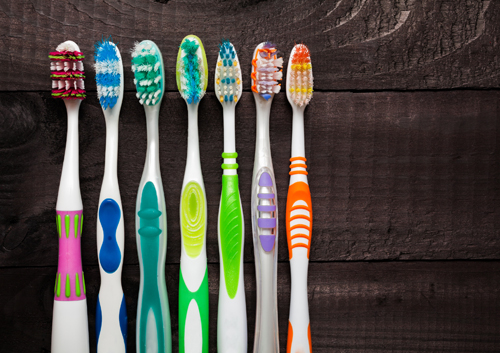
If you were to put your toothbrush bristles under a high-powered microscope, what you would see might give you nightmares: millions of bacteria, busily crawling up and down your toothbrush bristles, consuming proteins that came from your mouth, and still clinging to the bristles even after you’ve rinsed them with water.
Rinsing your toothbrush after brushing removes some of those ferociously hungry bacteria, but not all. The American Dental Association says that bacterial infestations develop on toothbrushes within a month of daily use. The ADA also states that unless a toothbrush is sterilized before being packaged, it’s going to come with bacteria – free of charge!
Germs and Frayed Bristles: the Demise of a Toothbrush
Dr. Todd Hamilton and our staff recommend that you toss your old toothbrush in the trash and purchase a new one every three months. Children tend to bite on their toothbrushes, which makes the bristles degrade and fray faster. Chances are kids may need to have their toothbrushes changed more frequently.
Where do they hide?
Bacteria are tenacious little germs that head for those concealed areas between toothbrush bristles. They are highly adaptable and exist in every type of extreme environment. Some people actually go so far as to put their toothbrush in a microwave for a few seconds to kill germs, but this doesn't always work either. In fact, you may only end up with a toothbrush that’s as bendable as a Gumby doll – and still covered with germs.
Feed a Cold, Starve a Fever, and Get Rid of Your Toothbrush
When you have a head cold, your mouth is teeming with bacteria gleefully roaming around, and gobbling mucus and dead skin cells. If you brush your teeth while suffering a sinus condition, the brush will act like a magnet for ravenous bacteria. Use your old toothbrush while you are sick, but as soon as you feel better, throw it away and get a new one. Otherwise you could possibly re-infect yourself with the same cold germs!
July 27th, 2016

Wearing braces limits some of the snacks you can eat. However, you still have plenty of choices for fun and healthy foods that will not harm your braces. You can even enjoy a few crunchy treats as long as you choose them carefully.
Sweet Treats
Puddings provide a sweet and safe snack while you are wearing braces. You can even select flavored puddings such as caramel to satisfy the urge for items you should not eat. They can be purchased already made or whipped up at home. You can even select low-sugar varieties that still taste good. Ice cream and yogurt are also choices; just avoid products with nuts.
Healthy Snacks
Fruits are excellent for a healthy snack. You just need to avoid biting into hard fruits such as whole apples. You can avoid the problem with fruit cocktails packed in water. Cocktails still have the nutritional benefits and flavor, but contain softer pieces. Avoid fruits packed in heavy syrup, though; these tend to have too much sugar.
Crunchy or Salty Snacks
Not all crunchy foods are bad; you just need to limit the crunch. Walnuts are a softer nut that can normally be eaten safely. Small cheese crackers satisfy the need for crunchy and salty. You can also allow pieces to dissolve slightly in your mouth before chewing, to reduce any risk.
Soft granola bars are also an option. Check the granola ingredients to ensure there are no large nut pieces, and brush your teeth afterwards. Otherwise pieces can become stuck in your dental work.
If you have any questions about safe snacks, do not hesitate to ask Dr. Todd Hamilton and our staff.